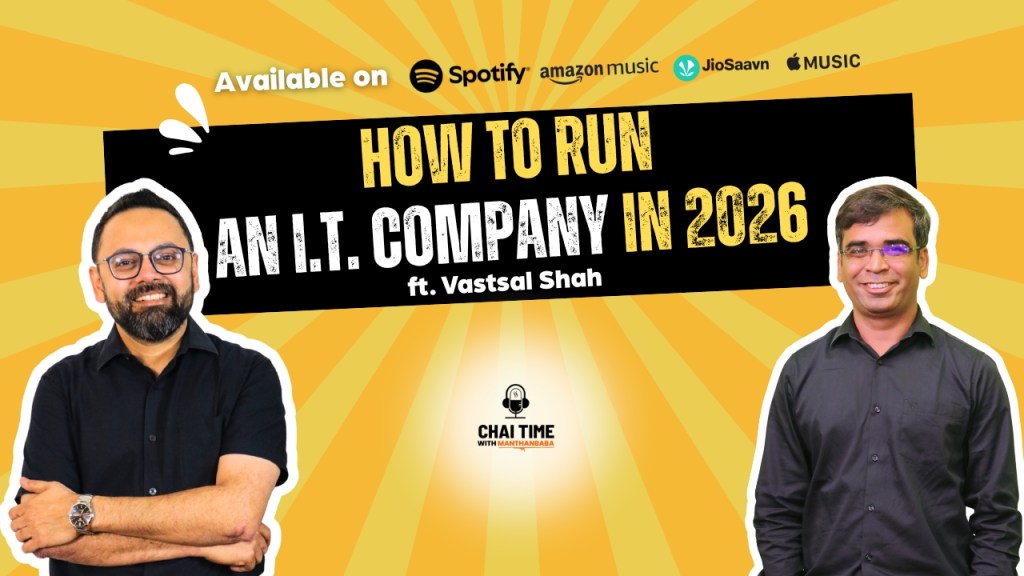
In my latest episode of Chai Time With ManthanBaba, I sat down with Vatsal Shah, an IT CXO coach and industry mentor, to dissect the challenges and opportunities awaiting IT founders as we approach 2026. Our conversation moved beyond the typical buzzwords, focusing instead on the psychology of leadership, the structural shifts in business models, and the urgent need to redefine “growth” in an AI-driven era.
The Founder’s Mirror: Psychology and Goal Alignment
Vatsal pointed out that most founders actually know their problems; they often come to mentors seeking validation rather than discovery. However, growth only begins when one moves past the “ego” of being the best and starts practicing “self-reflection”. Vatsal suggests that founders should step out of the “frame” of their daily operations to objectively assess their performance across all areas—finance, marketing, and technology adoption.
A critical pain point we discussed was alignment between partners. In single-founder firms, the company is a reflection of one person’s mindset. But with multiple partners, different backgrounds and risk appetites can lead to conflict. Vatsal noted that while one partner might want to expand globally, the other might prefer the safety of recurring revenue. For a company to scale toward 2026, these individual “personal goals” must be aligned so they do not hurt the collective “company goals”.
Strategic Goal Setting for 2026
Vatsal argues that 2026 demands a more sophisticated approach to goal setting than just “increasing revenue”. He identifies several key headers that should form a company’s goal structure:
- Strategy: Defining what your company will be known for in two years and deciding which offerings to cut.
- People: Budgeting for senior versus junior talent and deciding on the next development centre.
- AI Infrastructure: Moving beyond physical office costs to “soft infrastructure” like SaaS platforms and AI spend.
- Marketing and Sales: Identifying which of the 25+ available lead generation channels—from inbound pull marketing to outbound hunting—actually fit your price point.
The Service vs. Product Dilemma
Many service company owners view a product as a “life raft” when their service business slows down. Vatsal warns against this “mental fog”. He explains that building a product is only 20% of the battle; the remaining 80% is sales and distribution.
The shift requires a fundamental change in mindset: service is “Make to Order,” while a product is “Make to Stock”. Unless a founder has specific subject matter expertise and the patience for long-term investment (SIP) without immediate returns, the product is likely to fail. He also notes that if you run both models, they must have separate marketing and sales teams because the sales cycles and “finiteness” of offerings are entirely different.
Pricing and the AI Revolution
One of the most profound shifts Vatsal highlighted is the end of the traditional link between “man-hours” and “price”. With the advent of Agentic Development, tasks that previously took 400 hours can now be completed in 28. This renders hourly billing obsolete.
Vatsal urges founders to adopt Value-Based or Outcome-Based Pricing. He shared a powerful example of a firm that increased its package from $499 to $1699 simply by gaining the confidence to justify its value. The difference between charging $20 and $40 per hour is often just “the confidence of the salesperson”.
The Data and Networking Trap
In our talk, Vatsal also touched upon the “fear of data” in the Indian landscape, where many founders are hesitant to share information, even though most of it—like LinkedIn profiles or case studies—is already public. He advocates for the “Unification of Data” to track a customer’s entire journey across different platforms.
Furthermore, he cautioned against “Over-networking”. Comparing yourself to others in communities can lead to a “downward spiral” of anxiety if you only see their “makeup” (fake success). Instead, network with those who foster progress, or spend that time on self-improvement and books.
Final Thoughts
Vatsal’s core message for 2026 is simple yet demanding: “Good is not good when better is possible”. Whether it is implementing automation to augment human thinking or resetting pricing policies to reflect AI efficiencies, the IT leaders who thrive will be those who value reflection over ego and value over hours.
 Manthan Bhavsar – Growth-Focused Tech Leader
Leave a comment